The award-winning documentary “Disposable Humanity” held its university premiere on October 24 at Mizzou. The film, which took more than 20 years to complete and spans multiple generations, examines the Nazi Aktion T4, a forced euthanasia program that targeted adults and children with disabilities.
The documentary follows disability studies scholars who journeyed through Germany and Poland to visit former Aktion T4 killing centers where more than 300,000 people were murdered. This largely overlooked program trained killing staff and enabled the development of gas chamber technology utilized during the Holocaust.
“‘Disposable Humanity’ memorializes hidden and painful history from the perspective of disabled people, and chronicles their resilience and activism,” said Julie Elman, director of the Center for the Humanities and associate professor of women’s and gender studies. “The result is a film that’s disturbing and hauntingly beautiful.”
A discussion with the documentary filmmakers followed the screening with a powerful student-led conversation on the Nazi regime’s first step towards genocide.
The Center for the Humanities supports novel interdisciplinary research in the humanities and undertakes public outreach and teaching at the local and state level. Humanities research improves lives by deepening our understanding of ourselves and each other: the individual and collective aspects of human experience, cultural heritage, and creative expression.
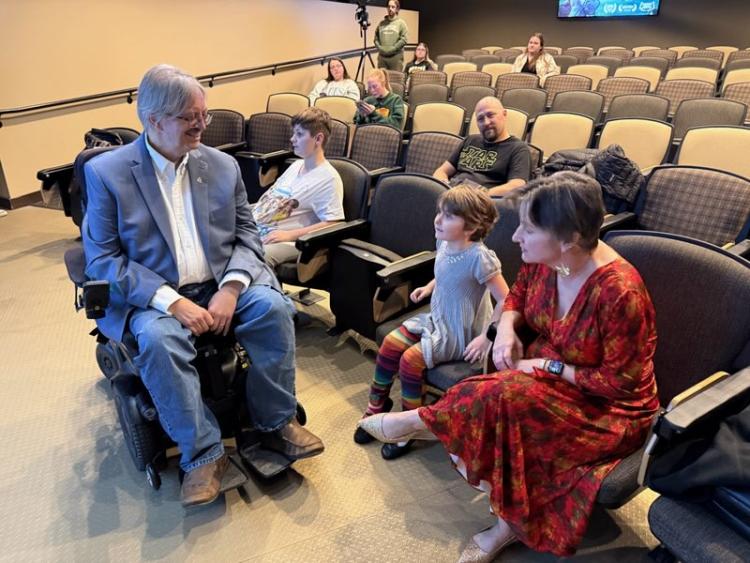
Julie Elman, director of the Center for the Humanities and associate professor of women’s and gender studies, visits with David T. Mitchell, a disability studies professor and documentary filmmaker, prior to the screening.