
Ezra Mendelson and Kaitlyn Koob meet with Mathew McIntosh, to discuss the Keno project, an undergraduate research initiative in the Department of Statistics and Data Science.
When Kaitlyn Koob arrived at Mizzou, she expected to learn statistics in the classroom. She didn't expect her work would help state lottery systems improve the accuracy of information provided to players or introduce her to cutting-edge research at the intersection of artificial intelligence and clinical trials.
Now an incoming junior majoring in statistics and data analysis, Koob is taking advantage of multiple undergraduate research opportunities in the College of Arts and Science, gaining hands-on experience that is preparing her for future career and graduate school opportunities.
One of those opportunities is the Keno Project, an undergraduate research initiative in the Department of Statistics and Data Science led by Matthew McIntosh, assistant teaching professor of statistics and data science.
The project began with a partnership between student researchers and the Missouri Lottery to improve the statistical transparency and accuracy of the state's KENO game. Since then, the effort has expanded beyond Missouri, with students auditing lottery probability models, verifying published odds, and communicating findings to lottery systems across the country.
For Koob, the project has provided a unique opportunity to apply statistical concepts to a real-world problem.
"Dr. McIntosh teaches me what I needed to know while giving me space to experiment and learn through my own practice," Koob said. "He leaves room for us to be creative and express our ideas. His mentorship has allowed me to learn and develop into a better student and researcher."
The Keno Project has produced seven student co-authors, two publications and a national statistics podcast interview, with additional manuscripts currently in development. Students continue their work throughout the academic year through the Undergraduate Statistics Research (USTAR) Center, which was established in 2024 with support from a Forward Student Success Enhancement grant from Mizzou's Office of the Provost.
Koob's research experience extends beyond Keno.
This summer, she participated in the College of Arts and Science's Summer Research Exposure Program (SREP), which provides stipends that allow first- and second-year undergraduates to work alongside faculty mentors on research and creative activity projects.

Sounak Chakraborty meets with Kaitlyn Koob to discuss her Summer Research Exposure Program project.
Through SREP, Koob worked with Sounak Chakraborty, professor of statistics and data science, on research involving causal inference, artificial intelligence and clinical trials. Her work focused on how researchers can use real-world and historical patient data in situations where traditional randomized control groups may be impractical or ethically challenging.
"Kaitlyn gained hands-on experience applying these emerging approaches, including causal adjustment, counterfactual prediction, model validation and sensitivity analysis," Chakraborty said. "The work illustrates how undergraduate research can contribute to developing more efficient, transparent and scientifically credible approaches for generating clinical evidence in the era of real-world data and artificial intelligence."
Chakraborty will continue mentoring Koob during the academic year through extended SREP funding, allowing her to build on the skills she developed this summer.
For Koob, experiences like these highlight the value of undergraduate research and the faculty mentors who help students navigate it.
"Undergraduate students are often new to the research process, so faculty mentorship plays an important role in helping them learn how to develop research questions, apply appropriate methodologies, analyze data and communicate findings effectively," McIntosh said. "Faculty mentors help students navigate the challenges that naturally arise such as refining ideas, managing setbacks and maintaining academic rigor."
The College of Arts and Science supports undergraduate researchers through initiatives such as SREP and Support for Undergraduate Research Activities and Travel (SURAT), which provides funding for research expenses, conference travel and fieldwork opportunities.
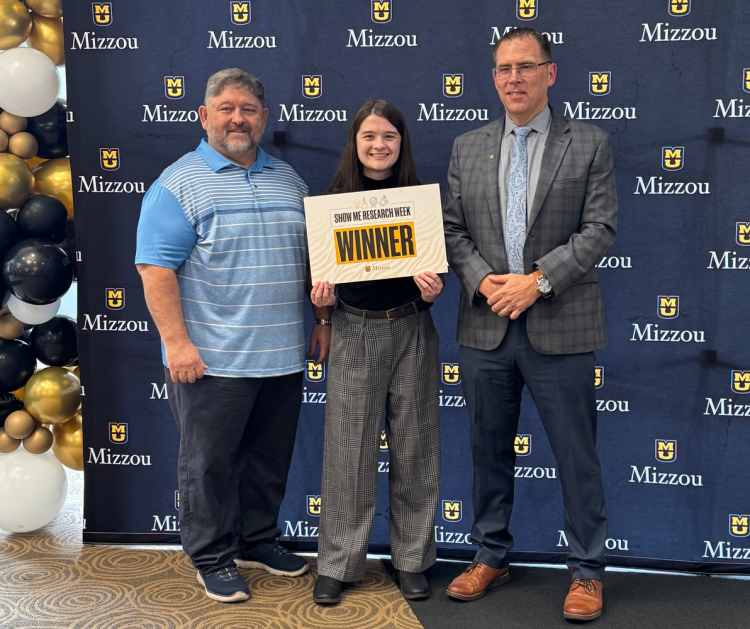
Kaitlyn Koob, recognized for her Keno research presentation during Show Me Research Week, with Matthew McIntosh and Matthew Martens, Provost and Executive Vice Chancellor for Academic Affairs.
According to McIntosh, the benefits of research extend far beyond individual projects.
"Employers and graduate programs value research experience because it demonstrates initiative, perseverance, creativity and the ability to solve complex problems," he said. "These students are developing stronger communication and leadership skills, as well as the confidence to contribute ideas in collaborative settings."
As Koob prepares for another academic year, she plans to continue her work with the KenoProject while expanding her research experience through ongoing faculty collaborations. Her journey illustrates how Arts and Science students can move from learning statistical concepts in the classroom to using them to address real-world challenges, all while building the skills and confidence needed for future success.
Find Funding for Your Research
Turn curiosity into discovery through the College of Arts and Science’s undergraduate research programs. The Summer Research Exposure Program (SREP) connects early-career students with faculty mentors for hands-on research and creative experiences, while Support for Undergraduate Research Activities and Travel (SURAT) provides funding for research activities, conference travel, and fieldwork.