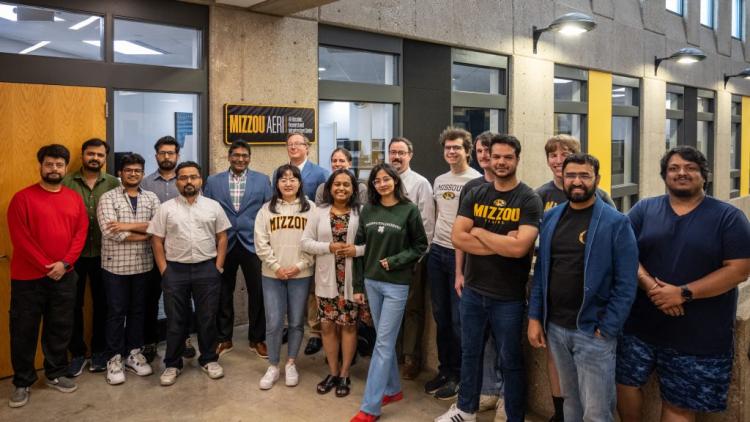
Jointly supported by the Colleges of Engineering, Arts and Science and Department of IT, AERI will be a hub for interdisciplinary AI research and development
Artificial intelligence (AI) is rapidly transforming research, industry and workforce needs across nearly every sector of society. To position the university for leadership in this evolving landscape, the University of Missouri is launching the Mizzou AI Education, Research and Infrastructure Center (AERI), a new interdisciplinary initiative jointly established by the College of Engineering, the College of Arts and Science, and the Division of Information Technology to connect AI expertise, computing infrastructure and applied research across campus.
AERI will serve as a collaborative foundation for broader university-wide engagement in AI research, education and innovation. The center will help build the computational infrastructure and interdisciplinary partnerships needed to support AI-driven research across domains, including the use of large and complex datasets to improve analysis, modeling and decision-making.
In addition to advancing research, AERI will support workforce development initiatives that prepare students and professionals to work effectively with AI technologies across a rapidly evolving economy. The center will also help strengthen engagement with industry, government agencies and small businesses seeking to adopt AI tools and data-driven approaches within their own operations and communities.
Reflecting the interdisciplinary nature of the initiative, AERI’s leadership structure brings together expertise in AI research, faculty collaboration and advanced computing infrastructure from across the university.
Curators’ Distinguished Professor Prasad Calyam in the College of Engineering will serve as the founding executive director of AERI. A nationally recognized researcher in AI-enabled cyberinfrastructure and advanced computing systems, Calyam will help guide the center’s efforts to connect AI research, computational resources and external partnerships across the university.
“AI permeates nearly every major discipline at Mizzou,” Calyam said. “Faculty across campus are using AI to model complex systems, analyze data and develop new tools for discovery and application. AERI creates the collaborative and technical framework needed to connect these efforts and expand their impact.”
Clintin Davis-Stober, Middlebush Professor of Psychological Sciences in the College of Arts and Science, will serve as co-director of AERI, with a focus on strengthening interdisciplinary research and faculty engagement. Davis-Stober previously founded Mizzou’s AI Research Interest Group (AI RIG), which helped build an early cross-campus community around AI research and collaboration.
Matthew Keeler, director of IT Research Support Solutions in the Division of Information Technology, will serve as associate director and help lead efforts related to cyberinfrastructure, data governance and scalable AI operations. His experience supporting advanced research computing environments will help ensure that AERI can meet the growing technical and data needs associated with AI research and deployment across disciplines.
“Establishing a collaborative AI initiative directly supports the research, educational and public service missions of a flagship public university,” Davis-Stober said. “AERI creates new opportunities for interdisciplinary collaboration while helping prepare students and researchers to engage thoughtfully with the opportunities and challenges created by AI.”
“We are proud to help launch AERI as a collaborative initiative that brings together expertise from across disciplines,” said Cooper Drury, dean of the College of Arts and Science. “The center creates new opportunities for faculty and students to engage in one of the most transformative technological developments of our time while advancing research and education that serve Missouri and society.”
“Artificial intelligence is rapidly reshaping how society works — from healthcare, manufacturing and agriculture to education, national security and scientific discovery,” said Marisa Chrysochoou, dean of the College of Engineering. “Universities have a responsibility not only to advance these technologies, but also to help society understand, adapt to and benefit from them.”
“AERI creates a collaborative foundation for Mizzou to contribute to that future through research, workforce development and partnerships that connect technological innovation with real societal needs,” she said.