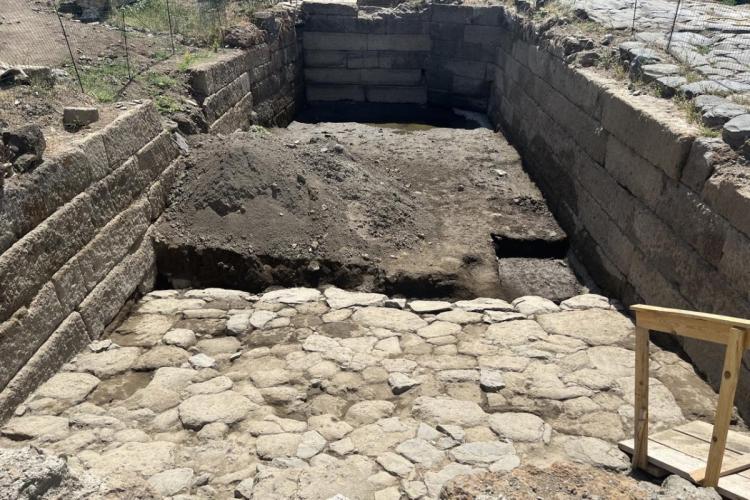
In the heart of the ancient Roman city of Gabii, located just 11 miles east of Rome, archaeologists discovered the remains of a massive stone-lined basin, partly carved directly into the bedrock.
Oct. 16, 2025
Contact: Eric Stann, StannE@missouri.edu
Photos courtesy Marcello Mogetta
In the heart of the ancient Roman city of Gabii, located just 11 miles east of Rome, a team of archaeologists led by University of Missouri professor Marcello Mogetta has made a remarkable discovery: the remains of a massive stone-lined basin, partly carved directly into the bedrock.
Built around 250 B.C., with evidence that some parts may be even older, this man-made structure may be one of the earliest examples of Roman monumental architecture other than temples and city walls.
Mogetta, the chair of Mizzou’s Department of Classics, Archaeology and Religion, said monumental architecture is about more than realism — it’s also a powerful tool for political expression.
This story originally appeared on Show Me Mizzou.
Want more stories like this? Subscribe to the Show Me Mizzou Newsletter.