Aug. 12, 2025
Contact: Eric Stann, StannE@missouri.edu
Graphic by Bangzheng “Tom” Sun
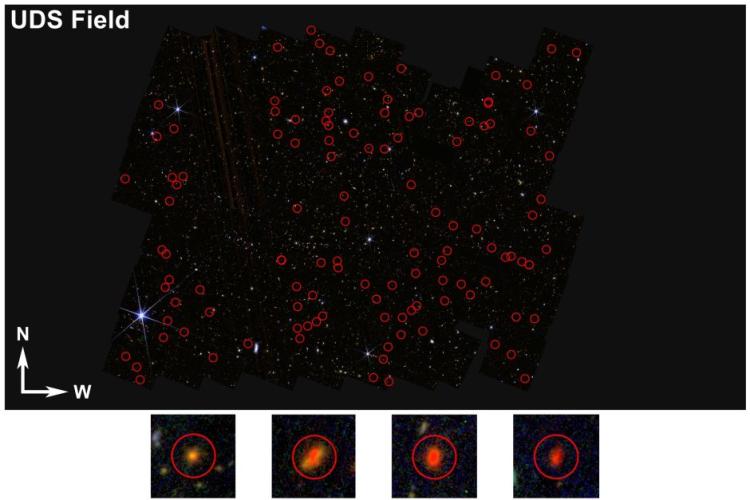
In a new study, scientists at the University of Missouri looked deep into the universe and found something unexpected. Using infrared images taken from NASA’s powerful James Webb Space Telescope (JWST), they identified 300 objects that were brighter than they should be.
“These mysterious objects are candidate galaxies in the early universe, meaning they could be very early galaxies,” said Haojing Yan, an astronomy professor in Mizzou’s College of Arts and Science and co-author on the study. “If even a few of these objects turn out to be what we think they are, our discovery could challenge current ideas about how galaxies formed in the early universe — the period when the first stars and galaxies began to take shape.”
But identifying objects in space doesn’t happen in an instant. It takes a careful step-by-step process to confirm their nature, combining advanced technology, detailed analysis and a bit of cosmic detective work.